The load L is being hoisted by the pulley and cable arrangement shown. Each cable is wrapped securely around its respectively pulley so it does not slip. The two pulleys to which L is attached are fastened together to form a single rigid body. Calculate the velocity and acceleration of the load L and the corresponding angular velocity ω and angular acceleration α of the double pulley under the following conditions:
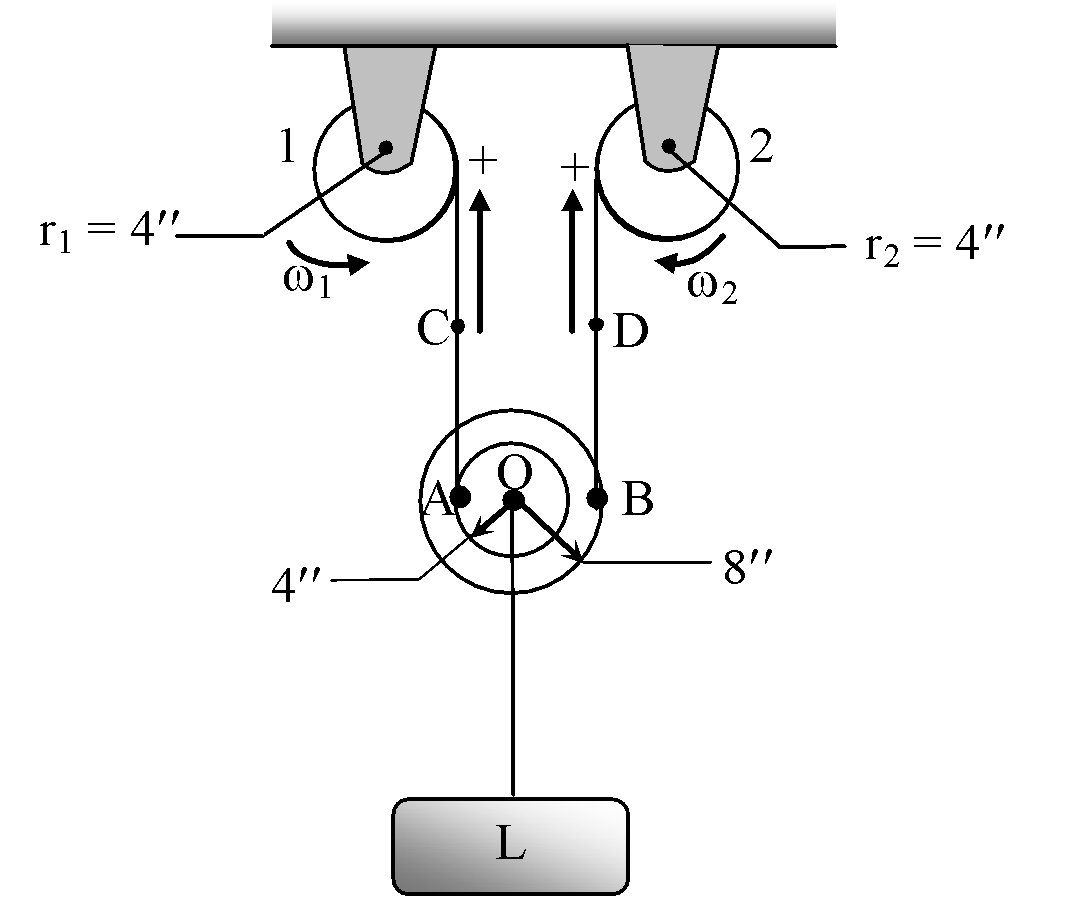
Case
 = 0 (pulley at rest) Pulley 2 : ω 2 = 2 rad/sec, α 2 =
  = –3 rad/sec 2 Case
 = 4 rad/sec 2 Pulley 2 : ω 2 = 2 rad/sec, α 2 =
  = –2 rad/sec 2
Text Solution
Verified by ExpertsCHECK THE SOLUTION.
Sol. The tangential displacement, velocity and acceleration of a point on the rim of pulley 1 or 2 equal the corresponding vertical motions of point A or B since the cables are assumed to be inextensible.
Case : With A momentarily at rest, line AB rotates to AB ′ through the angle d θ during time dt . From the diagram we see that the displacements and their time derivatives gives
ds B =  d θ v B =
  (a B ) t =
ds O =  d θ v O =
  a O =
a O = 
With v D = r 2 ω 2 = 4(2) = 8 in./sec and a D = r 2 α 2
= 4(–3) = –12 in./sec 2 ,
We have for the angular motion of the double pulley
ω =  =
=  = 8/12
= 2/3 rad/sec (CCW) Ans.
α =  =
=  = –12/12
= –1 rad/sec 2 (CW) Ans.
The corresponding motion of O and the load L is
v O =  = 4(2/3) = 8/3 In./sec Ans.
a O =  = 4 (–1) = – 4 in./sec 2 Ans.
Case . With point C, and hence point A, in motion, line AB moves to A ′ B ′ during time dt . From the diagram for this case, we see that the displacements and their time derivatives give
ds B –ds A =  d θ v B – v A =
  (a B ) t –(a A ) t =
ds O –ds A =  v O –v A =
  a O – (a A ) t =
With v C = r 1 ω 1 = 4 (1) = 4 in./sec
v D = r 2 ω 2 = 4(2) = 8 in./sec
a C = r 1 α 1 = 4 (4) = 16 in./sec 2 a D = r 2 α 2 = 4 (–2) = –8 in./sec
2 we have for the angular motion of the double pulley
ω =  =
=  =
= 
= 1/3 rad/sec (CCW) Ans.
α =  =
=  =
= 
= –2 rad/sec
2 (CW) Ans.
The corresponding motion of O and the load L is
v O = v A +  = v C +
  = 4 + 4 (1/3)
= 16/3 in./sec Ans.
a O = (a A ) t +  = a C +
  = 16 + 4 (–2)
= 8 in./sec 2 Ans.
Helpful Hints :
(i) Recognizer that the inner pulley is a wheel rolling along the fixed line of the left-hand cable. Thus, the expressions of previous problem hold.

(ii) Since B moves along a curved path, in addition to its tangential component of acceleration (a B ) t , it will also have a normal component of acceleration toward O which does not affect the angular acceleration of the pulley
(iii) The diagrams show these quantities and the simplicity of their linear relationships. The visual picture of the motion of O and B as AB rotates through the angle d θ should clarify the analysis.

(iv) Again, as in case , the differential rotation of line AB as seen from the figure establishes the relation between the angular velocity of the pulley and the linear velocities of points A, O and B. The negative sign for (a B ) t = a D produces the acceleration diagram shown but does not destroy the linearity of the relationships.
Prepare Smarter with CGP Edu
Get practice questions, solutions, and test series in one place.
Write a Review
Share your experience with this question and solution.
Commentary
Send your comment, doubt, correction, or feedback to admin.
Similar Questions
Explore conceptually related problems